

Continuing Education: A High-Return Investment in Your Employees
“Those who don’t move with the times will be left behind by them!”
Is that just a tired cliché – or an economic principle? The answer is actually quite simple: the ongoing development of, for example, technologies and regulations requires regular further training even after completing a qualified apprenticeship, in order to remain professionally up to date. It’s no coincidence that we speak of “lifelong learning.”
That’s why any hesitation around employee training – something that can occasionally be observed especially among small and medium-sized companies – is misplaced. Costs and benefits are sometimes viewed rather critically, or entrepreneurs worry that the newly “trained” employee will show up at payroll demanding a raise, or, in the worst case, leave the company altogether. Of course, you can never completely rule that out – but if it does happen, the reasons usually run deeper.
Employees who are (and remain) professionally up to date help their company operate efficiently and competitively in the market – and in doing so, they also help secure their own jobs.
In a company that can act confidently in the market as a result, employees also feel secure and appreciated—so why would they simply give up such a job? Training gives participants the opportunity to question existing routines constructively through expanded knowledge and practical skills, and to develop impulses for change. It doesn’t mean reinventing the wheel – yet even small adjustments can lead to noticeable improvements in day-to-day workflows. And when the new knowledge starts to bear fruit in the company after some time – perhaps through being passed on to colleagues – a perceptive boss will know what to do…
For that reason, there really shouldn’t be two opinions about the necessity – and the value – of investing in employee development.
Generation Z Wants to Learn
Generation Z is now entering working life and is setting different priorities when it comes to training than previous generations. Studies have shown that Generation Z believes training is the key to professional success, spends more time on LinkedIn Learning than the average user, and believes expert knowledge develops faster today than it used to.
Young professionals are therefore well aware of how strongly ongoing technological progress will influence the way they work – and that continuing education is fundamentally essential in professional life. If employers make training opportunities “visible,” they increase their attractiveness – especially for candidates from Generation Z.
So the same applies to training as it does elsewhere: “Do good – and talk about it.” Show promptly, directly, and without frills on your website and social media channels when you have completed training programs. With little effort, you can publish a few posts with photos from the course, or even share a short video from the entire “event.” That way, you will be noticed more by Generation Z, too. Because supporting training measures is an indication that a company invests in its employees and aims for long-term retention – exactly what Generation Z is looking for.
One Rule Always Applies: The Training Must Fit
A bigger challenge, however, can be identifying the right option from the confusing variety of training offers available.
That’s why, before selecting a training measure, the entrepreneur should ask: “What should my employee X be able to do (better) after this training?” Or conversely: “Which skills are missing in my company – and which employee is best suited to learn them?”
For training that is mandatory due to general legal requirements – such as the asbestos expertise required for ASI work under the Hazardous Substances Ordinance (12/2024) – this question does not arise, of course.
For “voluntary” training, however, the goal should always be clearly defined in advance. It is certainly true that training is a form of appreciation, and this should also be communicated positively to employees. But if a course is offered merely to keep an employee happy and make them feel recognized, it usually will not lead in the medium term to the positive effects described above—for either side. Training must therefore be tailored to the employee’s current or future tasks and goals, and a person who is informed about this beforehand approaches the training with a very different level of motivation.
From Demolition for Demolition: The DA Service GmbH Offer
Once you know which of your employees you want to train in which area, you will often find what you are looking for in the course and seminar program of DA Service GmbH – especially whenever demolition-specific content is involved.
The DA Service GmbH program covers the following areas:
Occupational safety,
construction management,
hazardous substances, and
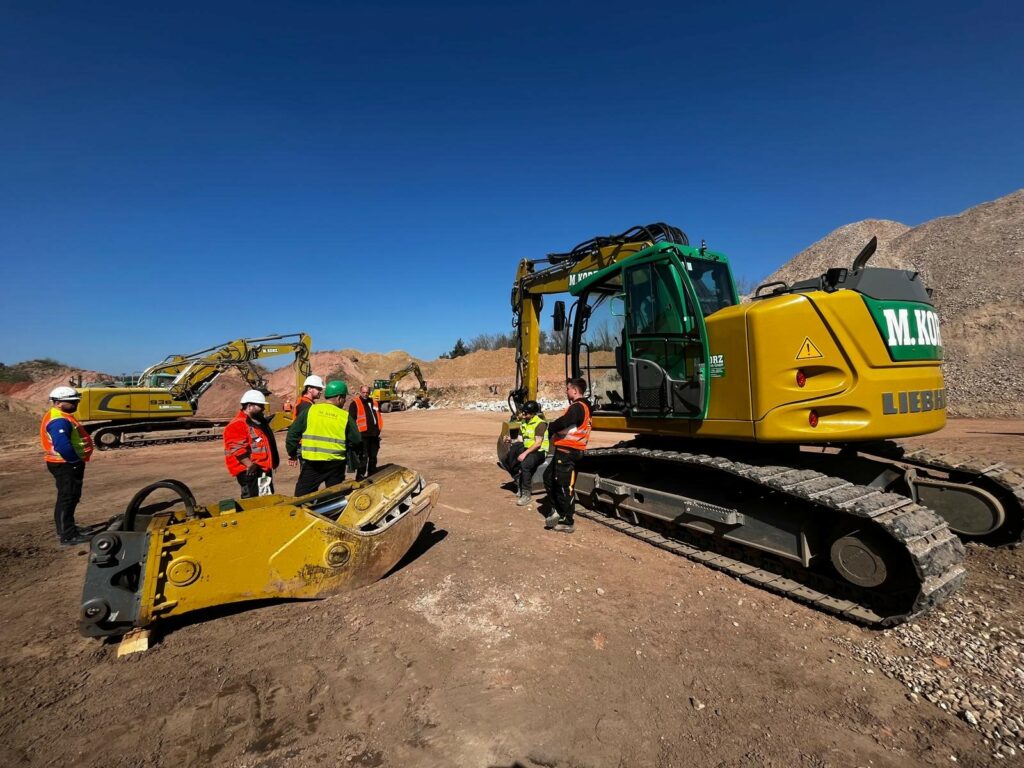
machine training courses.
All continuing education offers from DA Service GmbH – some of which were developed based on suggestions from specialist committees – are consistently tailored to the specific requirements of the demolition industry. Only what actually matters in demolition is taught here (and not, for example, in building construction), and what demolition professionals can genuinely apply in their daily work. This is ensured by carefully selected speakers who are used in DA Service GmbH events and who have the necessary practical experience with the demolition industry in the respective training topics – for example, in the VOB seminars.
DA Service GmbH training offers take place both in person and in hybrid formats. In addition, many programs can also be booked as in-house training at your company. Please inquire at the association’s office.
One not insignificant side effect of any in-person training measure is that employees from different companies can exchange ideas – often leading not only to technical discussions, but also to personal connections. Breaks and shared dinners during multi-day events are always good opportunities for this, and contacts often emerge that last beyond the duration of the training itself.
John F. Kennedy is credited with saying: “An investment in education is expensive. Even more expensive is not doing it.”
So invest in the most important capital of your company: your employees.