

No Staff in the Danger Zone
Cat Command’s First-Time Use in a Building Demolition Project
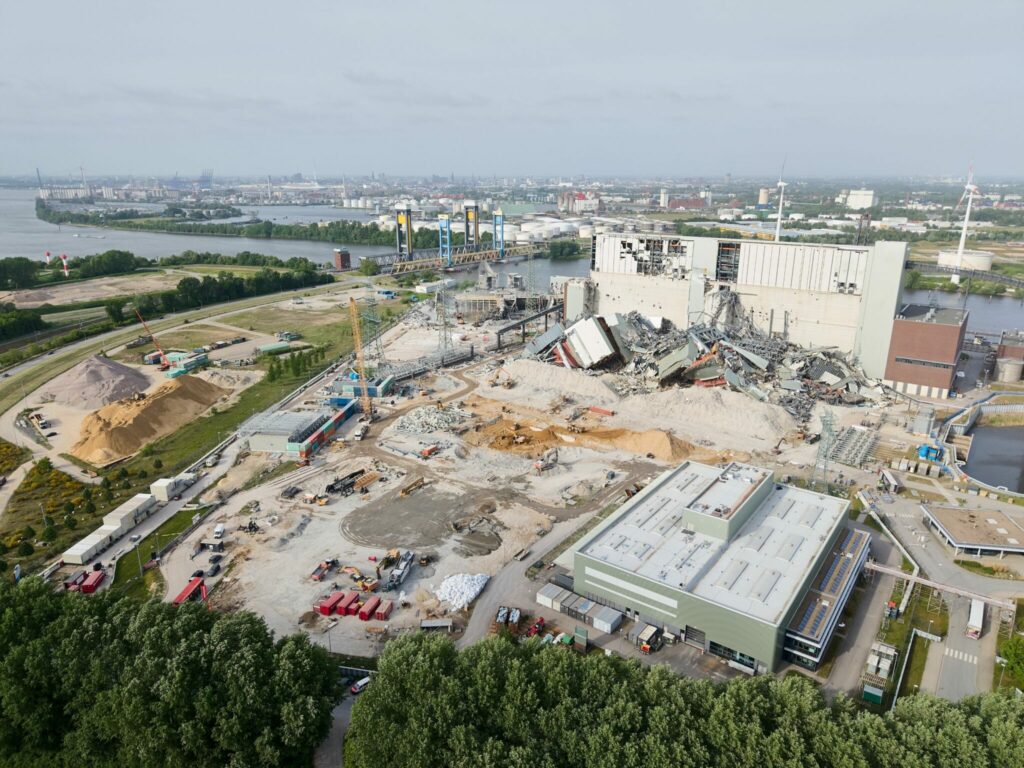
At the end of March 2025, the two boiler houses – each weighing around 24,000 tonnes – at one of Europe’s largest hard-coal power plants in Hamburg were to be brought down by blasting. However, because one of the two identical boiler houses did not collapse due to a misfire, an alternative demolition concept was required.
The plan was for the already partially blasted boiler house to be brought down by targeted pre-weakening of the load-bearing steel columns and a subsequent additional blast, causing it to tip forward and collapse.
The top priority of this alternative concept was to keep all personnel out of the danger zone, because the first blast had altered the original structural stability. “That means the forces were distributed across very different components that previously had to bear hardly any loads,” explains Jens Hofmann, Head of the Demolition Division at the Hagedorn Group. A safety radius of 200 meters was therefore established around the second boiler house, which could not be entered. For this reason, the Hagedorn Group decided to use the Cat Command remote-control system in a building demolition project for the first time – an unprecedented step in Germany. Together with the Cat 395 tracked excavator, the remote-control technology formed the basis of the alternative concept: targeted mechanical weakening of the structure was intended to create the conditions for a successful second blast. Among other things, bolts holding the steel columns together had to be knocked off. “Absolute precision was required here, because the bolts had a diameter of just five centimetres,” Jens Hofmann explained.
The mobile Cat Command console enables the operator to control all machine functions safely from a distance, away from the machine. The console-based remote-control system is fully integrated into the excavator’s electronic and hydraulic systems to ensure fast response and smooth operation. Operating commands are transmitted by radio directly to the machine’s electronics, enabling real-time control – so the excavator performs exactly the functions and commands specified by the operator, who remains in visual contact at all times and can monitor the machine’s movements.
Additional cameras in the form of GoPros mounted on the excavator boom transmitted live images to two monitors to better control the excavator’s direction of travel. A drone also accompanied the operation continuously to provide additional oversight.
During the operation, the drone pilot and machine operator were positioned at a height of around 35 metres on a work platform in order to have the best possible view of the work area. In addition, real-time laser and radar monitoring was installed on the roof of the machine house, so that after each column was worked on, a radio-based check could be carried out. “With every further step on the columns and braces, the question was: has the building moved or not,” Jens Hofmann emphasises. “The continuous evaluation of all monitoring results made it possible to pull the excavator back in a controlled manner in time and bring the building down as planned with a final targeted blast.”
In the end, the Hagedorn Group successfully completed its fifth power plant project using Cat Command, gaining valuable experience for the future. “Zeppelin also played a major role in this. The employees were solution-oriented and really went the extra mile,” Jens Hofmann praised the collaboration. “The concept that was developed not only proved itself, but will in future serve as a tested solution for comparable extreme situations in demolition,” he said, assessing the technology’s potential.
Contact Information
Zeppelin Baumaschinen GmbH
Sonja Reimann
Graf-Zeppelin-Platz 1
85748 Garching near Munich, Germany
Tel.: +49 89 3200 0636
sonja.reimann@zeppelin.com
www.zeppelin-cat.de