


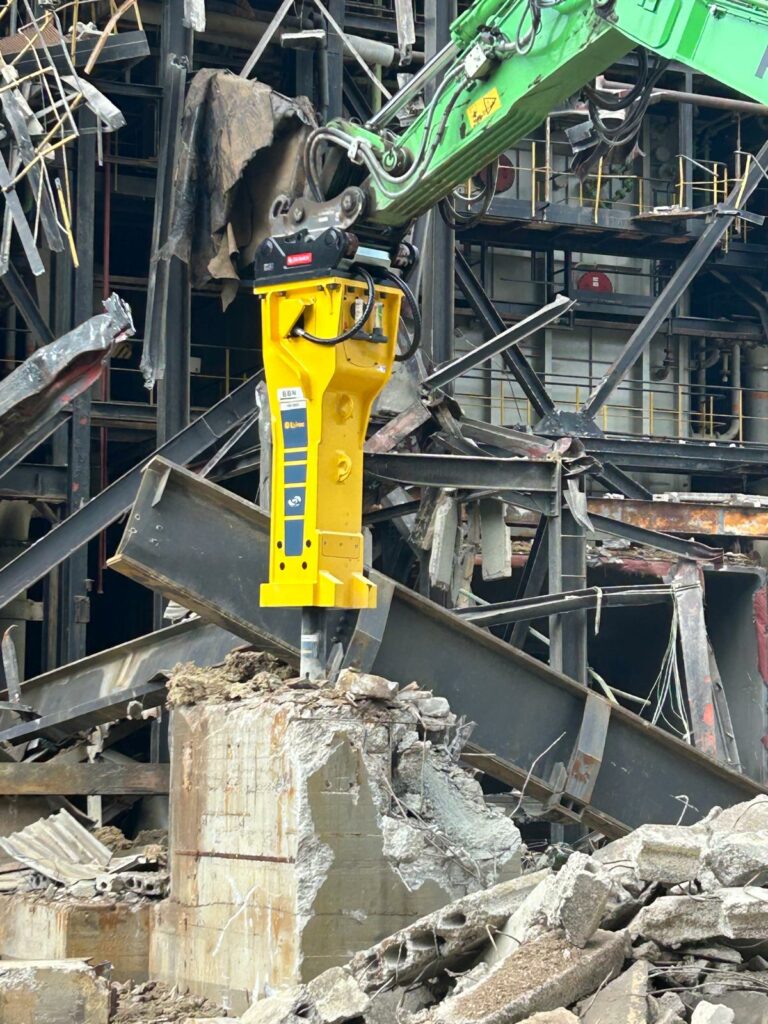
Power plant demolition using the new Epiroc HB 5800 hydraulic breaker
High impact energy enables efficient demolition of massive concrete structures
As part of the energy transition, a major demolition and dismantling project in Germany’s Ruhr region is entering its next phase: Unit F of the Scholven hard-coal-fired power plant is scheduled to be completely dismantled by 2026. Regrata Abbruch und Recycling GmbH & Co. KG, a company within the Matthäi Group, is responsible for project management on behalf of Uniper Kraftwerke GmbH.
The dismantling of Unit F marks another step in the site’s transformation. The objective is to build a new combined-cycle gas turbine power plant (CCGT), which is also designed to be capable of operating on hydrogen in the future. For the demolition works, Regrata is deploying a wide range of specialized heavy equipment. Of particular note is the new Epiroc HB 5800 hydraulic breaker. With an operating weight of 5,800 kg, this attachment is suitable for carrier machines in the 58- to 100-ton class. Its high impact energy enables the efficient demolition of massive concrete structures – an essential advantage when dismantling complex power plant installations.
“The use of the Epiroc HB 5800 supports Regrata in the technical execution of this demanding project. It combines performance and reliability – the fundamental requirements for completing such complex tasks. For this reason, Regrata has relied on Epiroc hydraulic breakers for many years,” explains Björn Bassen, authorized signatory and senior construction manager at Regrata.
The scope of demolition includes all main plant and auxiliary facilities of Unit F. In addition to the Epiroc hydraulic breaker, long-reach demolition excavators with operating weights of up to 175 tonnes, crawler lattice-boom cranes, and high-performance crushing and pressing plants are being used.
Thüringer Sprenggesellschaft, also part of the Matthäi Group, is involved in the blasting engineering demolition of several buildings within Unit F. Despite the significant technical and logistical requirements, the project is progressing according to plan. The construction period is scheduled from April 2024 to September 2026.
With the demolition of Unit F, one chapter of industrial history comes to an end – and at the same time, a new one begins. The planned CCGT plant marks the transition from fossil-based to climate-friendly energy generation.