

What Our Employees Really Need
Report from Berlin: Between Skills Shortages and Bureaucratic Madness
A lot is being debated in Berlin: heat pumps, climate targets, the big push to cut red tape. But surprisingly little is said about the people who are ultimately expected to make all of this happen. In the construction and demolition industry, we have known for a long time: without employees, nothing works. No machine, no dismantling, no recycling.
Our skilled workers are the real capital of our companies. They operate specialized equipment, they often work under difficult conditions, and they carry responsibility for safety, quality, and deadlines. In short: they are the foundation for keeping projects on time and on budget — and for ensuring that politically defined goals on circular economy, resource conservation, and recycling can actually become reality.
Yet while policymakers endlessly refine new regulations — from CSRD to REACH, from EBV to NKWS — evidence and documentation requirements are piling up in companies. This ties up resources precisely where they are needed most: out on the jobsite. You could say: if you tie people up with paperwork, you shouldn’t be surprised when they’re missing on the construction site.
Political Berlin seems to believe that skilled workers can be conjured up through ever more regulation. Reality looks different: we only attract them if the framework conditions are right. That means less bureaucracy and more clarity, better training and continuing education, and faster recognition of foreign qualifications. It also means housing, mobility — and above all: planning certainty.
And it means better acknowledging the commitment of those who already carry more than their share of responsibility. In construction and demolition, overtime is not an exception — it’s everyday reality. It is needed when deadlines are tight, when something unexpected happens on site, or when a project simply has to be finished.
That this extra effort is taxed the most heavily is an anachronism. A different, noticeably lower taxation of overtime would help employees directly and would be a real relief for companies, because it creates flexibility when capacities are tight. Here, too, it becomes clear: appreciation must not only be expressed in words — it has to be felt in people’s wallets.
Another piece of this puzzle is the federal government’s current plans for the so-called Aktivrente (“active pension”). Anyone who reaches the statutory retirement age and voluntarily continues working should in future be able to earn up to €2,000 per month tax-free, in addition to their regular state pension. That may sound technical, but it has very practical effects: older employees could remain involved for longer without their additional work being immediately subject to full deductions. For many, it is an incentive to contribute a few more years of experience, knowledge, and energy — on terms they can decide for themselves.
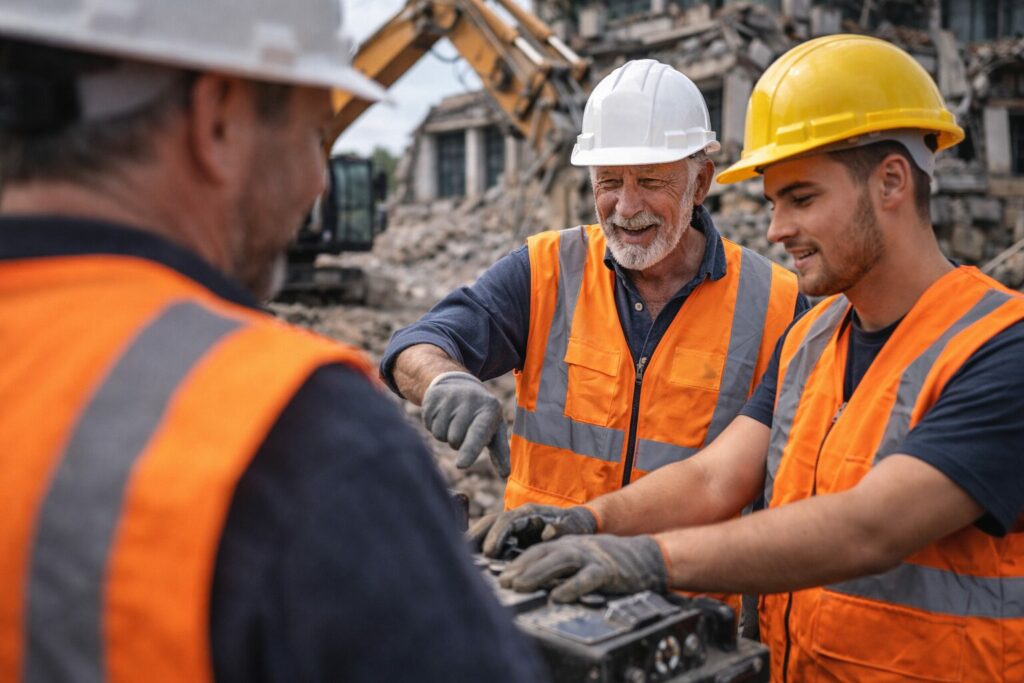
For the demolition industry in particular, this is a gain: decades of practical know-how do not automatically disappear at the statutory retirement age — they can continue to be used, whether project-based, part-time, or in an advisory role. An experienced machine operator explaining the finer points to a younger colleague is worth more than any brochure on recruiting skilled workers.
And in the context of a circular economy in construction, this has special significance: those who have known material flows for decades understand how materials can be separated, processed, and reused. This experience is a key lever to ensure recycling is achieved not only on paper, but in practice.
Of course, not everything about the Aktivrente is unproblematic. Contributions to health and long-term care insurance would still be due, and it remains unclear how exactly the scheme will be designed for different occupational groups. Critics also warn of high costs for the state. But the approach is right. Because it relies on voluntariness rather than coercion — and it acknowledges that performance in later life is not automatically worth less.
For companies, this means they can retain employees’ expertise for longer, pass on knowledge in a targeted way, and send a strong signal at the same time: a lifetime of work counts. For employees, it means more choice and more recognition. And for policymakers, it would be a chance not only to talk about the circular economy, but to actually create framework conditions that help.
Berlin likes to talk about “people at the center.” It sounds good — but too often it remains a slogan. If we truly understand our employees as capital, then we must have their backs in everyday working life: less paperwork, more trust. Fewer rules, more recognition. Machines can crush materials, laws can set quotas — but it is the people on our sites who turn that into a circular economy. From apprentices to retirees.
Without them, there is no circular construction economy!
Contact Information
Dipl.-Ing. (FH) Katrin Mees
Head of Berlin Office
German Demolition Association (Deutscher Abbruchverband e. V.)
Kronenstraße 55–58
10117 Berlin, Germany
Tel.: +49 30 20314 524
mees@deutscher-abbruchverband.de
www.deutscher-abbruchverband.de