


A look beyond borders
A look at Belgium, Norway, and the USA
The know-how required of demolition and deconstruction companies has steadily increased over recent decades and is highly diverse. Sustainability and urban mining are the current megatrends that are visibly shaping – and challenging the demolition sector. The following examples show how these developments are being implemented abroad.
Belgium, Brussels: A new high-rise with an old core
Since the 1950s, historical building fabric in the Belgian capital has often been replaced in an unstructured way by modern large-scale projects. The emergence of social hot spots and reputational damage to the demolition sector (“wreckers”) were just two negative consequences of this approach. A particularly striking example that Brussels—and the demolition industry—have been taking a different path for several years is the “ZIN” project, completed in 2024.
The building is located in Brussels’ Northern Quarter, the so-called “Manhattan of Belgium.” Since the pandemic, a large share of the many office towers there had stood empty, putting the district at risk of becoming another problem area. To bring life back to the neighborhood, the two office towers of the World Trade Center (WTC), situated in a central location, were to be repurposed. In 2017, a decision was therefore made to transform the site from a purely office district into a multifunctional area with apartments, a hotel, leisure spaces, offices, restaurants, and cafés. This required demolishing the WTC and constructing a modern building ensemble. In advance, assessments were conducted to determine which materials from the two towers could be reused in the new “ZIN” building. For example, the flint stone slabs from the WTC plinth were identified as reusable and were used as flooring for ZIN’s new terraces.
The company G&A De Meuter nv from Ternat was commissioned to carry out the deconstruction of WTC Towers I and II. The firm also operates a sorting center for deconstruction materials, a recycling center for mineral construction materials, and a concrete plant.
In 2019, G&A De Meuter began dismantling the two towers, each around 100 meters high. Materials qualified for reuse were gradually removed, stored on site, and preserved. The buildings were not removed completely. Instead, the massive cores were to remain intact and structurally effective, becoming part of the new development—an approach that placed very high demands on deconstruction quality.
Keeping the two cores in place meant that 2 × 8,000 m³ of concrete remained on site. The same applied to the underground structure, which contained 50,000 m³ of concrete. For construction of the new building, 95% of the material was reused, 32% of it via recycling. With a floor area of around 100,000 m², ZIN—opened in 2024—became one of Europe’s largest urban mining projects.
As part of its urban mining strategy, Brussels is pursuing ambitious plans to promote the circular economy and sustainable urban development. Since 2019, the Brussels Region has adopted circular economy strategies that allow building demolition in the region only if a robust urban mining plan is in place.
Norway, Oslo: E-construction sites on the rise
The land of the fjords is remarkable in many ways. It generates nearly 90% of its electricity from domestic hydropower, has allowed only electric cars for new registrations since the beginning of 2025, and aims to be completely CO₂-free by 2050. As a result, the construction industry must also become carbon-neutral—supported by strategic plans and government funding programs that have been in place for several years. The Oslo region, as the sector’s largest client, has decided that emissions must generally be reduced by 95% by 2030. Since 2022, the use of mineral oil for heating or drying construction sites has been banned, and since July 1, 2025, there has been a blanket ban on using fossil gases on construction sites. From 2030 onward, all municipal construction sites are to be fully emission-free—a commitment also made by six other major Norwegian cities.
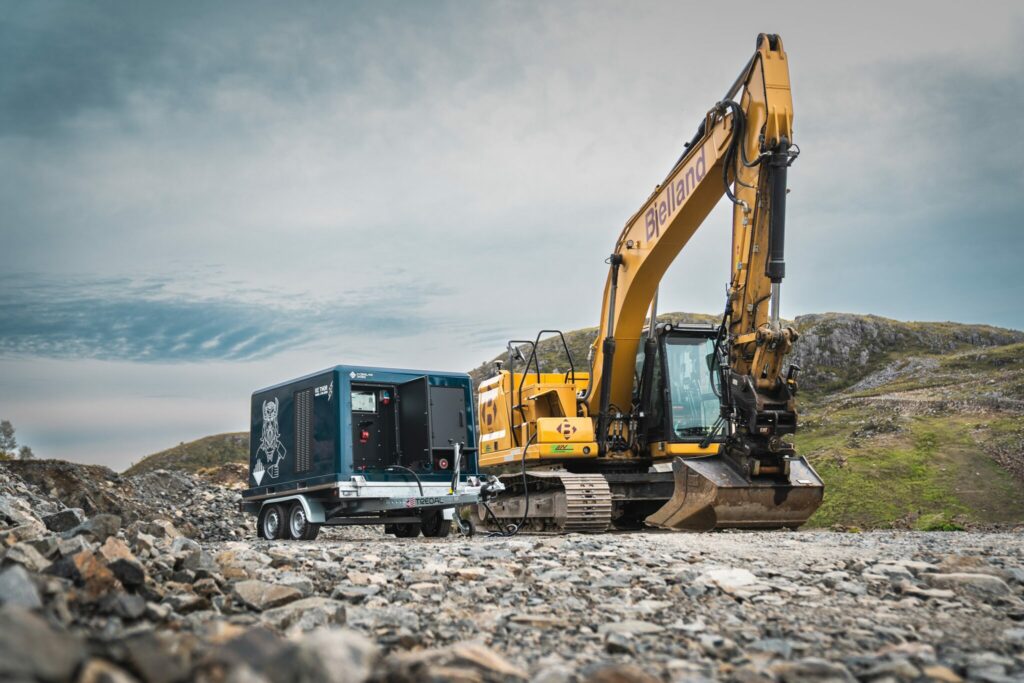
The path to emission-free construction sites is already underway. Since 2017, the state enterprise agency Enova has supported the deployment of more than 460 emission-free construction machines, and as early as 2019, the world’s first electric construction site was implemented in Oslo: the redesign of “Olaf Vs Gate.” The City of Oslo rented electric construction equipment and made it available to the contractor. The equipment used included an electric wheel loader, an 8-ton electric excavator with lithium-ion battery storage, and electric excavators of 25 and 16 tons with battery storage. Nasta AS, a leading construction machinery dealer in Norway, has been working since 2019 on converting selected machines from diesel to electric motors.
Norway—and especially the Oslo region—has supported further projects since 2022 with government funding and scientific backing, such as electric excavators for building a converter station and testing charging containers on construction sites. Founded in 2017, Kverneland Energi has positioned itself in this market and develops and operates mobile chargers specifically for construction sites, depending on the model with up to 1,152 kWh charging capacity.
In 2023, Enova launched two new programs aimed at reducing emissions in the construction industry: funding for emission-free construction machinery and funding for mobile batteries with integrated or separate charging units.
USA, Boulder: A small city – setting a big example
The United States is not only one of the world’s largest countries by area and population, but also a leader in technical innovation and high-rise construction culture. In the U.S., deconstruction is still largely viewed as “demolition” (tear-down). Innovative high-rise projects do not necessarily have innovative deconstruction as their foundation. Nationwide materials-flow management plays only a minor role, as landfills still have sufficient capacity. As a result, there are no uniform cross-state regulations governing recycling of demolition waste or the planning and execution of demolition work.
Against this backdrop, it was striking to see a small city in the American Midwest make sustainability in deconstruction a key benchmark for renovation and redevelopment projects.
The first building in the United States to be taken down according to the principle of selective deconstruction was located in Boulder, Colorado: the “Boulder Communal Health Hospital.” Deconstruction took place from 2019 to mid-2023 and was carried out by Ameresco from Boston. First, EIS Holdings from Fort Worth, Texas conducted an extensive hazardous materials assessment, followed by asbestos removal and disposal. This was followed by complete clearance of the building, under the requirement that a large proportion of installations and materials be removed intact and either reused or donated. During removal of the building envelope, concrete and brick were crushed on site and reused as fill material. Finally, the steel frame was deconstructed and stored on site—161 tons of steel in total, about one quarter of which was used for the construction of a new local fire station.
The legal basis was the “deconstruction ordinance” adopted by the City of Boulder in 2020. It mandates that buildings may only be dismantled selectively and that at least 75% of materials must be reused or recycled. The city also requires detailed deconstruction planning, including consideration of hazardous materials investigation and disposal, supported by corresponding permitting processes. Boulder has also established clear requirements for noise and environmental protection as well as occupational safety in deconstruction—until then, a novelty in the U.S.
That Boulder is not destined to remain an isolated outlier—and is instead becoming a role model—can be seen in the fact that the State of Colorado has since adopted some of its requirements, and that major cities such as Portland, Seattle, or Pittsburgh, and especially Palo Alto in California, are following Boulder’s example.
“The days when you could simply flatten buildings with a bulldozer are over.” (freely translated after Michele Crane, City Architect, Boulder)
The international perspective shows that Germany is among the global leaders in deconstruction technology and planning as well as materials-flow management. Two examples demonstrate that other, smaller countries have also set ambitious targets. The American example proves that the demolition sector—and the way resources are handled—is undergoing a (positive) transformation beyond Europe as well.
 Abbruch International - Über die Grenzen geschaut
 Download