


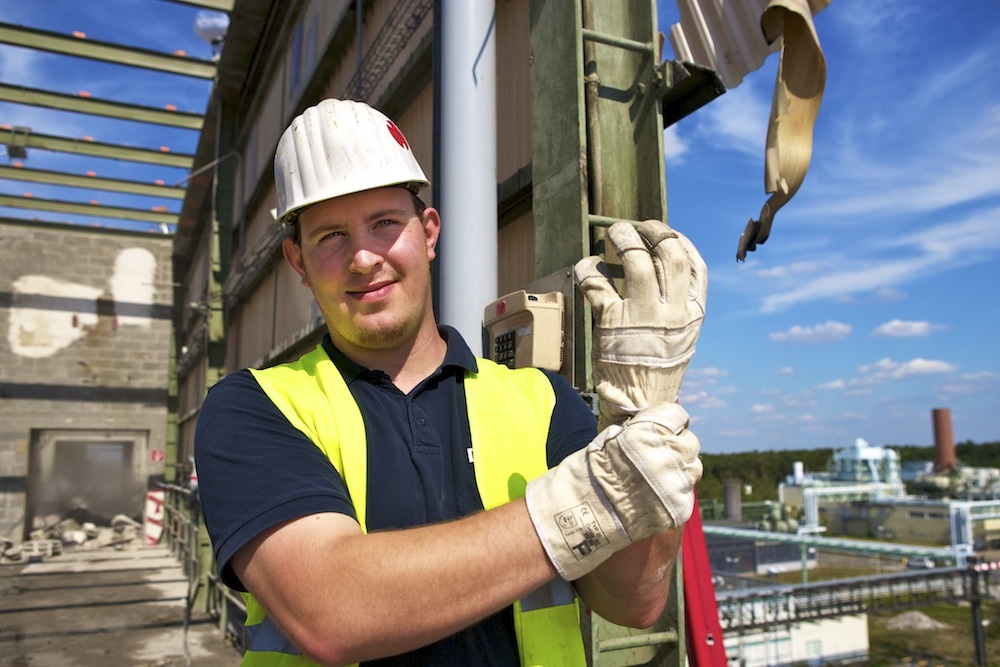
Demolition. New beginning. Construction transition.
Which role does the demolition industry play in the construction transition?
A bigger one than many people think.
The urban mine is our territory. We are the ones who search, sort, and secure. Without us, the loop stays closed — in the worst possible sense. Because what still lies dormant inside buildings today will be the raw material from which tomorrow’s construction transition is made.
Anyone who wants a construction transition mustn’t talk only about new builds, solar panels, and timber. They must also talk about deconstruction.
Our work often begins when others decide a structure has reached the end of its life cycle. But we don’t simply tear down. We assess, safeguard, and selectively dismantle — and we intervene only where preserving the existing structure is no longer technically, economically, or functionally reasonable. Much more often, we are the ones who create room through partial demolition so that something new can emerge: an extra storey, a change of use, a climate-friendly refurbishment.
A successful deconstruction is not a radical cut — it is a deliberate opening for new perspectives. That is exactly where our strength lies: preparing the way for the future with respect for what already exists.
The construction transition starts with deconstruction
Anyone speaking today about the future of infrastructure — about modern bridges, resilient roads, new rail lines, or vibrant residential districts — cannot avoid one central prerequisite: space must be made. But buildings in the process of being deconstructed are more than a pile of materials.
They are filled with valuable resources that have already been built in — and can now be made usable again. This is where the work of the demolition industry begins.
What may look like “demolition” on the surface is, in truth, targeted resource recovery. We reclaim high-quality materials — from concrete, brick, asphalt, or natural stone. We salvage steel, glass, and timber that can be given a second life in new construction projects. We unlock mineral secondary raw materials that replace primary resources, protecting the environment and conserving materials. And we bring deep expertise in deconstruction planning, hazardous-material remediation, digitalisation, quality assurance, and processing.
What we produce is still often labelled as waste. But in reality, we deliver the foundation of a circular economy in construction. Our work is based on verified standards, technical rules, and complete documentation. We deliver quality — with test certificates, traceable origins, and precise processing. Our industry does not improvise; it operates highly professionally. We run modern materials-flow management. And we do it with one goal in mind: making the construction transition possible.
The gold prospectors of the urban mine
An image helps to understand the potential: if architects design the showpieces of the construction transition, then we are the ones who find and extract the gold for them. We identify the hidden veins in existing buildings, analyse the materials, recover them, sort them, and prepare them with purpose. Only when this work succeeds can the design of the future become reality.
And our responsibility does not end with dismantling — it begins there. Because recycling is an integral part of our work. It happens within the demolition industry — from the first assessment through to quality-assured processing. We separate, process, produce recycled construction materials, and return valuable resources to the loop. Everything from one source — from our hands.
Whether deconstruction planning, selective dismantling, hazardous-material remediation, or producing quality-controlled recycled construction materials: the technical infrastructure is there. The processes are established. Our industry is innovative, solution-oriented, and well connected — with research, construction companies, and public-sector clients.
A construction transition without deconstruction? Unthinkable.
Anyone who truly takes the construction transition seriously cannot ignore us. Because the construction transition means: fewer primary raw materials, greater resource efficiency, lower CO₂ emissions, and stronger use of regionally available building materials. That is exactly our daily business.
And yet we repeatedly run up against limits — not because we can’t deliver. Not because the technology or know-how is lacking. But because existing regulations and political contradictions slow us down.
Why are quality-controlled recycled materials still classified as waste — even though they meet every requirement for quality, safety, and environmental compatibility?
Why is using secondary materials in public projects more complicated than it needs to be — even though technically proven solutions have long existed?
Why do procurement processes still so rarely commit consistently to circularity — even though that is exactly what policy demands?
We’re not asking these questions out of defiance — but because the answers will determine the future viability of our industry. And of the construction transition as a whole.
We’re ready — if we’re allowed
The demolition industry is not on the sidelines — it stands at the beginning. We are not the ones applying the brakes; we are the enablers. And we know: the transformation of the construction sector doesn’t begin with the first shovel in the ground — it begins with the first planned step of deconstruction.
What we need is not applause, but a political framework that makes our contribution the norm, not the exception. A construction transition that includes deconstruction from the outset. A circular economy that is not only written as a strategy, but enabled as reality.
We are the starting point of every circular building idea. Demolition today does not mean destruction — it means securing resources, creating space, and shaping the future. Or, to put it succinctly: demolition is the start of a new beginning.
We are ready to do our part. Not tomorrow — now.
 Demolition. New beginning. Construction transition. (in German)
 Download