

Making Money with Circular Dismantling
Cooperation with Purpose
Dismantling no longer marks the end of a building today, but the beginning of a new material cycle. This shift in perspective was at the heart of the joint presentation by the German Demolition Association (DA) and Concular GmbH at FACHTAGUNG ABBRUCH 2026.
The core message: circular dismantling works economically and in practice when everyone along the value chain collaborates — from the dismantling company to data and marketplace solutions, all the way to reuse in new construction.
Dismantling as the Starting Point of the Circular Economy
Circularity in construction does not begin at recycling plants or in material databases, but directly on the jobsite. That is where it is decided whether materials are destroyed or preserved. Modern dismantling companies now deliberately salvage components, identify reuse potential, and process materials so they can be integrated into new building projects.
This turns circular dismantling into an economic opportunity. Additional revenue can be generated by selling reusable components. At the same time, resources are conserved, waste volumes are reduced, and CO₂ emissions are avoided.
Collaboration Instead of Isolated Solutions
The presentation makes it clear that no single player can solve a system challenge on their own. Functioning loops emerge only through the interaction of different organizations.
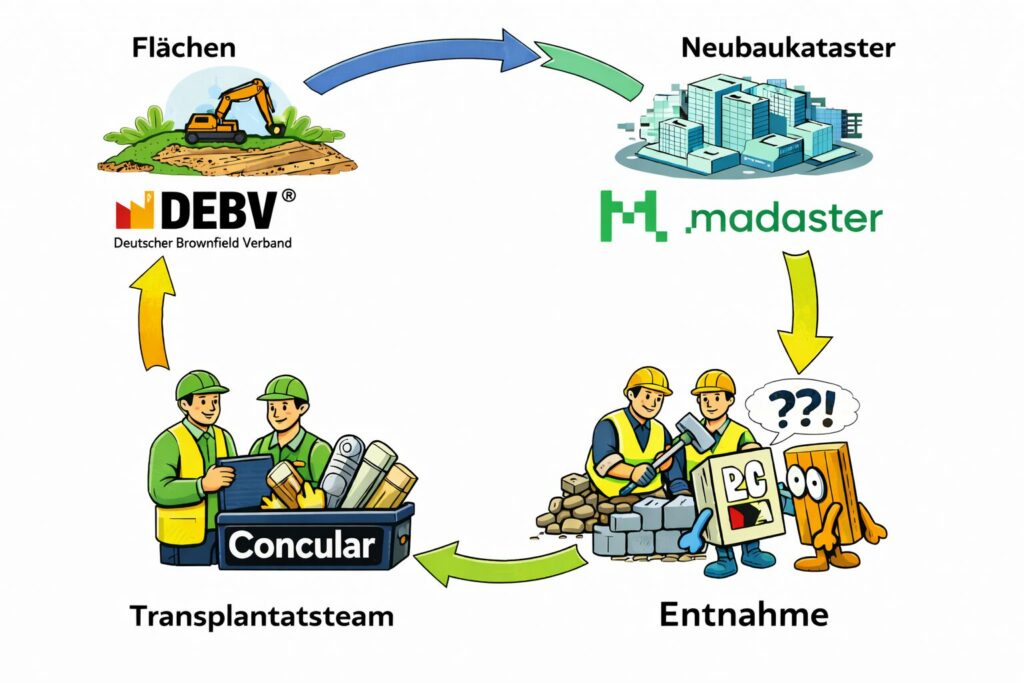
That is why, on the initiative of the German Demolition Association, a cooperation was launched together with the German Brownfield Association (DEBV), Madaster, and Concular. The aim is to highlight that every stakeholder fulfills an indispensable role within the loop — and that circularity can only work economically when these roles interlock.
It is also clear: if the loop is disrupted at one point, it ultimately affects everyone. This is precisely why the partners intend to support one another more strongly going forward, even though they operate at different points in the cycle.
Complementary Roles Within the Shared System
Within the cycle presented, the partners take on different but complementary roles:
The German Demolition Association (DA) stands at the beginning of the new cycle step. Dismantling companies extract what is commissioned from existing buildings, remove hazardous materials, secure reusable components, and prepare material streams so they can be fed back into the cycle. Wherever components can be reused as whole units, cooperation takes place with specialized partners such as Concular.
The German Brownfield Association (DEBV) supports the development and transformation of sites and existing locations. It helps make properties usable again, enabling new cycles to emerge in the first place — essentially “feeding” land back into the system.
Madaster documents materials and building data in new construction and creates transparency about today’s resources that will become tomorrow’s stock. This significantly facilitates later dismantling work. Early collaboration is therefore beneficial, because insights from dismantling and reuse can already feed into the documentation of future buildings, making materials easier to identify and reuse later.
Concular works with existing buildings and filters out those components that can be fully reused in an economically and technically viable way. Through digital marketplace solutions, these materials are channeled into new projects and kept directly within the loop.
Together, all parties mesh like stations within a shared system. The goal is to prioritize reuse wherever it is technically and economically sensible, thereby creating functioning markets instead of theoretical quotas.
A Practical Tool: The Joint Overview Graphic
A visible outcome of this cooperation is a jointly developed overview graphic presented during the talk. It provides quick orientation on which materials can already be reused or further used economically today and thus returned to the cycle. This overview will be continuously updated jointly: as soon as new economically viable solutions emerge, they will be added and made accessible to the industry.
Step by step, this creates a shared picture of how circular dismantling can work in practice — not as isolated initiatives, but as a joint project among all stakeholders within the loop.
Economic Examples from Practice:
Glazed fire-rated doors
The presentation illustrates, using glazed fire-rated doors, how dismantling can pay off economically. Whereas in conventional approaches dismantling and disposal costs often cancel each other out, non-destructive removal and subsequent marketing can generate additional revenue for the dismantling company.
Other components show similar potential.
Raised floors and system floors in office buildings
In many cases, system floors can be removed without destruction, palletized, and reused. Demand is particularly high where standardized office layouts exist. The economic benefit arises when floors are removed as clean fractions and marketed specifically via platforms.
LED lighting and high-quality interior fittings
Modern LED lighting systems or high-quality interior fittings such as doors or sanitary modules often still have a long remaining service life. If these components are dismantled professionally, tested, and bundled logistically, they can be reused cost-effectively in new projects.
Facade elements and modular components
In serially constructed buildings, façade elements or modular units can be dismantled and reused in other projects. Crucial here is early alignment between dismantling, marketing, and the future use location.
Logistics as the Key to Success
The success of such models depends heavily on logistics. What matters is:
- non-destructive dismantling,
- photographic and digital documentation,
- safe storage,
- standardized transport routes, and
- rapid placement with new buyers.
Concular plays an important role here as a specialized platform by bundling supply and demand and coordinating logistics.
For dismantling companies, this does not mean additional bureaucracy, but added value through structured processes.
Shared Responsibility Within the Loop
A central conclusion of the presentation is that no one in the loop can succeed alone. Site development, dismantling, documentation, and reuse interlock. If one element fails to function, the entire cycle stalls.
This is why cooperation between associations, companies, and platforms is becoming increasingly important. The aim is to contribute each party’s strengths while also supporting other stakeholders within the system.
Or, as the talk puts it metaphorically: dismantling companies and reuse platforms are, in a sense, working together at the “operating table.” Whatever still has value in the existing stock is carefully removed and put to use elsewhere.
Scaling Instead of Isolated Projects
The technical solutions already exist. Now the task is to scale these approaches and develop a functioning market out of individual projects. That requires planning certainty, economic incentives, and effective cooperation.
The conference clearly showed that the path from demolition to a circular construction economy is already underway. Now it is about continuing that journey together.
 Making Money with Circular Dismantling (in German)
 Download