


Small Technology – Big Impact
These Smaller Machines Take on Major Tasks
At first glance, demolition and deconstruction are dominated by huge machines, high tonnages and impressive performance figures. But a closer look reveals that size is not always the decisive factor when it comes to efficiency, cost-effectiveness and progress. Especially in times of skilled labour shortages, rising requirements for occupational safety and emission reduction, and a growing focus on selective deconstruction, it becomes clear that compact, specialised technology often has the greater impact.
Demolition Robots – Precision in Confined Spaces
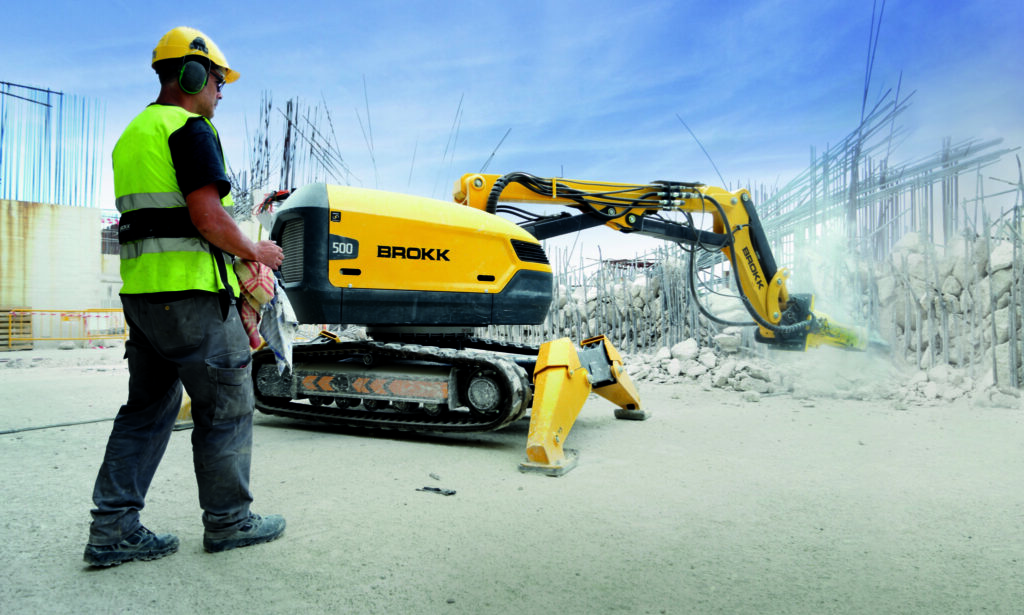
In recent years, demolition robots have evolved from a niche product into an integral part of modern deconstruction concepts. Manufacturers such as Brokk and Husqvarna offer compact machines which, thanks to their small dimensions and comparatively low weight, can even be used in sensitive areas – for example indoors, on floor slabs or in structurally challenging zones. With minimum dimensions of sometimes just 780 mm in width, the robots fit through standard doors and can even climb stairs or, with operating weights of under one tonne, be transported in lifts.
Despite their compact dimensions, their range of applications is highly versatile: from chiselling work and concrete removal with milling attachments to sorting grabs for selective deconstruction or the use of concrete crushers, demolition robots cover a broad performance spectrum. The decisive advantage, however, lies in productivity: a single operator controlling the robot remotely can replace the output of several workers using hand-held tools such as demolition hammers — one operator plus robot can replace three to six workers in manual demolition — while at the same time significantly reducing physical strain, maintaining consistent quality and causing only very minor performance loss.
There is also the safety aspect: the operator works outside the immediate danger zone, which is particularly important in contaminated areas or where unstable structural elements are involved. Looking ahead — and, thanks to the latest camera technology, in some cases already today — operation by a user who is not physically present inside the demolition object at all is becoming possible. Through AI and prior programming, autonomous operation without direct user control is also becoming increasingly conceivable.
In addition, demolition robots are electrically powered, offering further occupational safety benefits, particularly for indoor work, in terms of noise, vibration and exhaust emissions.
Mini Loaders, Mini Excavators and Electric Transport Solutions – Compact Powerhouses
The efficiency gains offered by compact technology are also clearly evident in material transport and supporting activities. Mini loaders such as the Sherpa 100, for example, can move loads of up to around 1,000 kg while remaining extremely compact — a level of performance that could only be achieved manually with considerable personnel requirements.
In practice, this means:
Material handling that would otherwise tie up two to four workers is carried out by one machine operator.
Transport cycles are significantly shortened.
Work interruptions caused by fatigue are almost completely eliminated.
Mini excavators and electric wheelbarrows complement this system, particularly in interior demolition. Electrically powered variants also enable low-emission work here, which is crucial especially in enclosed spaces or during hazardous substance remediation.
Another major advantage lies in ergonomics: the physical strain on employees is significantly reduced. Tasks such as manually pushing heavy loads or carrying construction debris are largely eliminated. This not only has a positive impact on employees’ health, but also increases the long-term attractiveness of the industry.
Crusher Buckets – High Throughput in a Small Format
Crusher buckets as excavator attachments are a particularly illustrative example of “small technology with a big impact”. Compared with stationary or mobile crushing plants, they may initially appear modest. Yet their potential is enormous. Modern models achieve throughput rates of around 20 to more than 100 tonnes per hour, depending on the material and grain size.
Compared with large-scale plants, crusher buckets are inferior in terms of absolute maximum output, but they offer significantly greater cost-effectiveness for smaller and medium-sized deconstruction projects. While mobile crushing plants can often only be operated economically from a certain material volume upwards, crusher buckets make profitable processing possible even with lower volumes.
In addition, a significant amount of organisational effort is eliminated: permits, space requirements and transport logistics are considerably reduced. This creates a clear advantage, particularly in inner-city deconstruction.
They also offer a high degree of flexibility: moving between different construction sites is quick and possible without heavy-load transport, unlike with mobile crushing plants, and their use can be adapted precisely to the requirements of the project.
Small Helpers – Major Effects
In addition to machines and attachments, there are numerous small technical solutions that are often underestimated in day-to-day work, but have a significant impact on efficiency, safety and environmental compatibility.
Innovative systems such as oil collection solutions, for example DERBLAUE, or integrated hydraulic safety systems, for example Oilfix, prevent leaks and reduce downtime. Even small quantities of leaking operating fluids can cause significant soil and groundwater contamination and seriously disrupt operational processes. Preventing such leaks therefore has a direct impact on both environmental performance and productivity.
Dust suppression systems and extraction technology are also examples of “small technology with a big impact”: they enable continuous work while complying with occupational safety limits, without interruptions caused by dust generation.
Digital and AI-based solutions are also becoming increasingly relevant:
Sensors for condition monitoring reduce unplanned downtime.
AI-supported material recognition improves separation quality in selective deconstruction.
Digital documentation increases traceability and process reliability.
These systems work together and lead to a measurable overall effect: reduced downtime, higher recycling rates and optimised processes.
Progress Is Not Measured in Tonnes
Demolition and deconstruction are undergoing a transformation. Alongside traditional large-scale equipment, compact, specialised technologies are increasingly becoming established and are being used precisely where they create the greatest added value. Demolition robots, compact transport technology and flexible processing solutions enable a significant increase in productivity per worker deployed and per construction site.
“Small technology – big impact” is therefore more than just a catchphrase. It describes a paradigm shift toward greater efficiency, improved occupational safety, increased flexibility and more sustainable operations.
Especially in the context of skilled labour shortages, rising environmental requirements and the growing focus on selective deconstruction, one thing becomes clear: small technology is not a replacement for large machines, but their intelligent complement.
It is not the biggest machine that makes the difference, but the most efficient combination.
And this is precisely where small technology has its greatest impact.
You can read this and other exciting articles in the new issue of ABBRUCH AKTUELL (in German).