


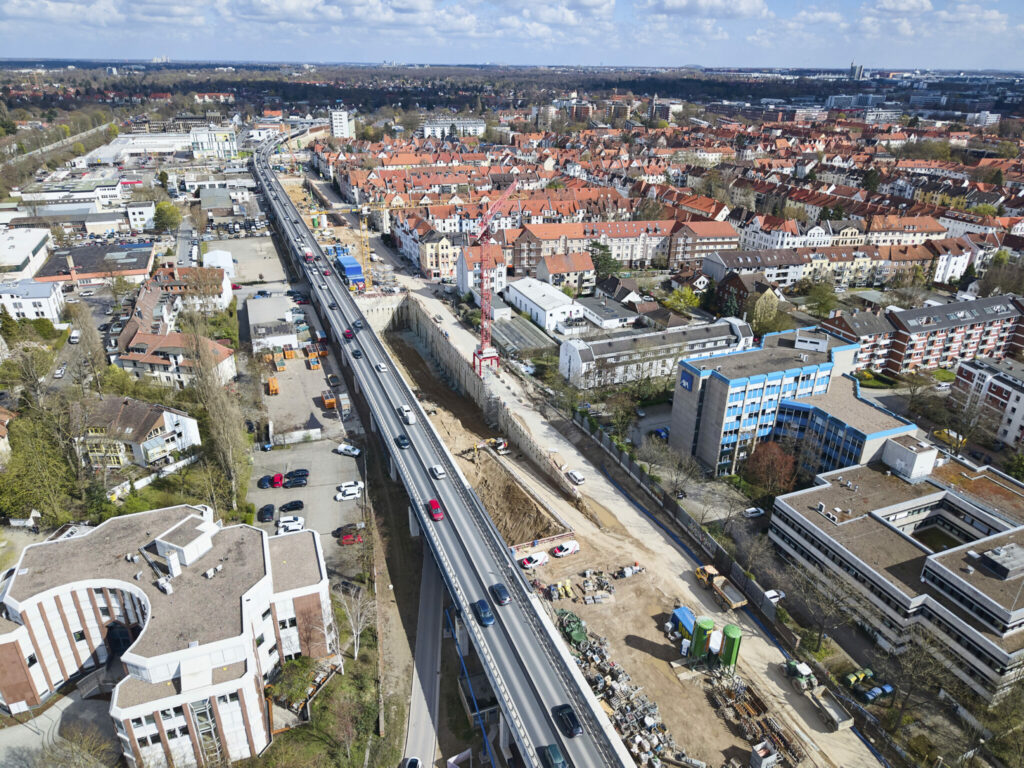
Complex Construction Work on Hanover’s Südschnellweg
Hagedorn drives major infrastructure project forward
The Hagedorn Group has been involved in the major Südschnellweg project in Hanover since 2023. Working alongside the other partners in the Südschnellweg joint venture, the company is carrying out key demolition, earthworks and specialist civil engineering operations. With a total project value of approximately €400 million and completion scheduled for around 2030, it is one of the most significant transport infrastructure projects in the region.
The aim of the project is to comprehensively modernise this heavily used transport corridor. The works include the demolition of the existing elevated road and the construction of a tunnel. A major milestone was reached in spring last year with the demolition of the approximately 484-metre-long existing bridge. Since then, work has focused on constructing the excavation pits and preparing for tunnel construction under complex urban and geotechnical conditions.
On the southern side, a diaphragm wall was constructed as a key element of the excavation support system. At the same time, the existing foundations were dismantled. Due to suspected unexploded ordnance, particularly precise methods were required, including the use of diamond wire saws. Extensive excavation work is another major focus of the project. In one construction section, approximately 55,000 cubic metres of soil were excavated under dry conditions to a depth of around 13.5 metres below ground level.
The excavated material is being systematically reused. Approximately 15,000 cubic metres were used to widen the embankment. Preparatory work for the installation of anchors is also under way, including preliminary excavation operations. The adaptation of existing infrastructure also forms part of the project. For example, the tram line was successfully relocated to a new, straight alignment across the excavation pit.
Technical highlight: underwater excavation and underwater concrete
Work in the sections close to the tunnel is particularly demanding, as Hagedorn is carrying out excavation below the groundwater level. While the central areas of the construction site can be worked under dry conditions, the excavation pits at the tunnel entrances temporarily resemble large water basins. Specialist methods and equipment are required in these areas.
Approximately 35,000 cubic metres of material are being excavated underwater, partly using machinery positioned on floating pontoons. At the same time, preparations are being made for the construction of the base slab. Significant progress was achieved with the completion of the first underwater concrete base slab, which provides the load-bearing and watertight foundation for the subsequent tunnel construction.
The concrete is poured underwater through a carefully coordinated operation involving divers, concrete pumps and site logistics. It is continuously placed and distributed in a controlled manner to create a homogeneous and stable layer. Maintaining an uninterrupted supply of material is crucial to ensuring the quality of the concrete. In one construction section, approximately 1,600 cubic metres of concrete were placed in a single continuous operation under challenging weather conditions and with a high degree of logistical precision.
“The work on the Südschnellweg demonstrates the complexity of modern urban infrastructure construction. Underwater excavation and underwater concreting in particular require precise planning, well-coordinated processes and the highest level of technical expertise. Successfully carrying out these demanding operations while traffic remains in service and under difficult conditions is a tremendous team achievement,” says Anton Bartel, Project Manager at Hagedorn.
Information
Hagedorn Group
Werner-von-Siemens-Straße 18
33334 Gütersloh
Germany
Tel.: +49 5241 5005 10
info@ug-hagedorn.de
www.unternehmensgruppe-hagedorn.de