


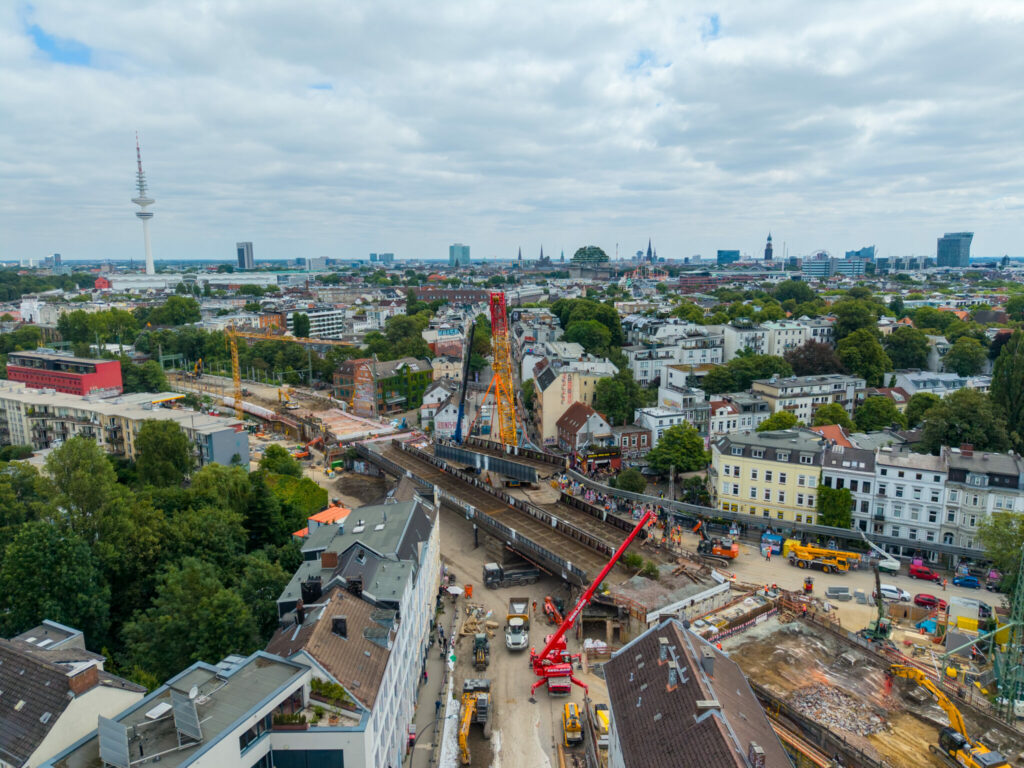
Hamburg’s Sternbrücke
Dismantling a century-old landmark
The dismantling of Hamburg’s Sternbrücke is undoubtedly one of the most technically demanding infrastructure projects of recent years. Few other projects combine the challenges of demolition in a dense urban setting, railway infrastructure, complex logistics and highly precise heavy lifting to the same degree. A&S Betondemontage GmbH carried out the dismantling of the historic railway bridge on behalf of the EÜ Sternbrücke joint venture (Himmel und Papesch Bauunternehmung GmbH & Co. KG and Fr. Holst GmbH & Co. KG) and, ultimately, Deutsche Bahn.
Dismantling under confined urban conditions
The Sternbrücke, around 100 years old, spanned one of Hamburg’s busiest intersections. Its immediate surroundings—residential buildings, businesses, railway infrastructure and heavily used traffic routes—meant that conventional demolition methods could only be used to a limited extent.
Instead of demolishing the structure in one operation, the team had to dismantle it in precisely defined sections. The work took place during a tightly scheduled closure of the railway line. The aim was to take apart the steel structure in a controlled way without affecting nearby buildings, tracks or utility lines.
Extensive protection measures were needed even during the preparation phase. Mobile Wege GmbH laid around 10,000 m² of steel plates to protect traffic areas, support site logistics and, in particular, prepare for the later transport of the new bridge. To transfer the exceptionally high loads from crane operations, heavy haulage and the bridge transport safely into the ground, an approximately 1 m-thick layer of mineral aggregate was installed beneath the plates, with precision down to the centimetre. This temporary surface for traffic and load distribution provided the basis for all heavy lifting and transport operations during the main construction phase.
Precision work on the steel structure
The historic steel structure was dismantled section by section. First, the individual structural elements were separated using flame-cutting techniques. Throughout every phase of the work, the remaining structure had to retain sufficient load-bearing capacity.
Making the specified cuts in the main girders was particularly demanding. The structure’s high inherent stiffness created considerable restraint forces and stresses. Each cut was therefore made in close coordination with the lifting operation.
After cutting, the steel sections were carefully lifted out and dismantled further at ground level. The individual bridge sections were up to 26 m long and weighed as much as 150 tonnes each.
To prevent the released structural elements from settling or deforming uncontrollably during dismantling, several hundred excavator mats were installed and stacked beneath the steel sections being removed. This allowed the loads to be supported in a controlled way during cutting and lifting.
The approximately 80 m-long steel superstructure was divided into around 60 individual sections. Immediately after dismantling, every section had to be transported by heavy-duty low-loaders, day and night, to a temporary storage site outside the city centre. There, a large crane unloaded the sections before they were sent for further reuse or storage. A 700-tonne crawler crane was used to rig and lift the sections.
Dismantling as part of an overall logistics plan
One distinctive feature of the project was that dismantling could not be treated as a separate operation. Preparations for installing the new bridge were already under way while the old one was being taken apart.
The work was not limited to the steel structure. The existing concrete bearing blocks, abutments and counterweights also had to be removed completely while the superstructure was being dismantled, so the site would be ready for the new bridge. This required substantial demolition work.
Within a tightly defined window of just 72 hours, around 3,500 m³ of reinforced-concrete structures were demolished, loaded and transported to a temporary storage site outside the construction area. At times, A&S deployed more than eight large machines simultaneously, working in two shifts around the clock. Carrying out the steel dismantling, concrete demolition and heavy haulage operations in parallel presented an exceptional organisational and technical challenge.
The successful dismantling of the historic Sternbrücke brings a chapter in Hamburg’s civil engineering history to a close. At the same time, the project paves the way for the opening of one of Germany’s most distinctive new bridges. The achievement, however, lies in the professional dismantling of the existing structure—a task every bit as impressive technically as sliding the new bridge into place.
Contact
A&S Betondemontage GmbH
Benzstraße 2
31275 Lehrte
Tel.: 05132 87270
info@betondemontage.de
www.betondemontage.de