

30 Years of the Construction Circular Economy Initiative
15th Monitoring Report again confirms high recovery rates – Deutscher Abbruchverband, a German Demolition Association, calls for better conditions for the use of recycled construction materials
BERLIN, 4 November 2026
More than 90 percent of mineral construction waste in Germany is recovered. This is shown by the 15th Monitoring Report of the Construction Circular Economy Initiative, which was presented today to Florian Bilic, rapporteur for circular economy for the CDU/CSU parliamentary group, at a parliamentary breakfast in the German Bundestag. At the same time, the initiative is celebrating its 30th anniversary. The Deutscher Abbruchverband (DA) is one of the initiative’s supporting associations.
On behalf of the DA, Katrin Mees, Head of the Berlin office, attended the presentation and the subsequent policy discussion in place of Managing Director Andreas Pocha.
High recovery rates demonstrate the industry’s capabilities
The monitoring report is based on data from 2024. Of the 175.2 million tonnes of mineral construction waste generated, 159.2 million tonnes were recovered. The recovery rate was 90.9 percent, once again above the figure for the previous reporting period.
A total of 64.3 million tonnes of recycled construction materials were produced from mineral construction waste. These met 13.2 percent of demand for aggregates. Including industrial by-products, the substitution rate was 17.5 percent.
The findings demonstrate the capabilities of the deconstruction, processing and recovery sectors. At the same time, they highlight the limits of available secondary mineral resources. Their volumes depend largely on the materials that actually arise from construction, refurbishment and deconstruction work.
Recovery does not guarantee marketability
The high recovery rate is an important achievement for the construction and recycling industries. However, it says little about how readily recycled construction materials can actually be marketed. The monitoring report tracks where the materials end up, but not demand, prices or potential sales difficulties faced by companies.
The DA believes it is therefore essential to safeguard existing recovery routes while also improving market conditions for recycled construction materials. Suitable secondary materials must be used wherever they can replace primary raw materials.
“Our aim is not to pit individual recovery routes against one another. What matters is that we make sensible use of the raw materials recovered through deconstruction, replacing primary materials. To do this, our companies need reliable framework conditions and a functioning market,” says Andreas Pocha, Managing Director of the Deutscher Abbruchverband e.V.
Bringing building preservation and resource recovery together
The National Circular Economy Strategy aims to significantly increase the use of secondary raw materials. At the same time, preserving and continuing to use existing buildings is becoming more important.
For the DA, these are not inherently conflicting objectives. Preserving usable buildings is an important contribution to conserving resources. Where buildings cannot be put to further use in a practical way and deconstruction is necessary, the raw materials they contain must be recovered to the highest possible standard.
High-quality deconstruction is therefore the first step in recovering raw materials from the existing building stock on an industrial scale.
Legal certainty for functioning material cycles
For recovered materials to be used again in the construction industry, practical requirements for processing, reliable quality assurance and a functioning market are needed.
The DA is particularly committed to establishing a clear legal end-of-waste status for suitable mineral substitute building materials. Together with the German Construction Industry Association (ZDB), it has developed specific regulatory proposals for the Substitute Building Materials Ordinance (EBV). With their broader approach of “circularity before disposal” (“Kreislaufwille vor Entledigungswille”), the associations are calling for secure subsequent use within quality-assured material flow systems to be given greater consideration in legal assessments.
Compliance with applicable environmental and quality requirements remains essential.
30 years of joint commitment
Since 1995, the Construction Circular Economy Initiative has documented the quantities and destinations of mineral construction waste in Germany every two years. The latest report is the first to show material flows since the Substitute Building Materials Ordinance (EBV) came into force in August 2023. However, the weak construction economy has led to a significant decline in construction waste volumes, masking potential effects of the EBV. It is therefore not yet possible to assess conclusively whether or how the new rules have affected recovery.
This makes it all the more important to use the forthcoming revision of the EBV to remove existing barriers and further facilitate the use of mineral substitute building materials.
The full 15th Monitoring Report is available at www.kreislaufwirtschaft-bau.de.
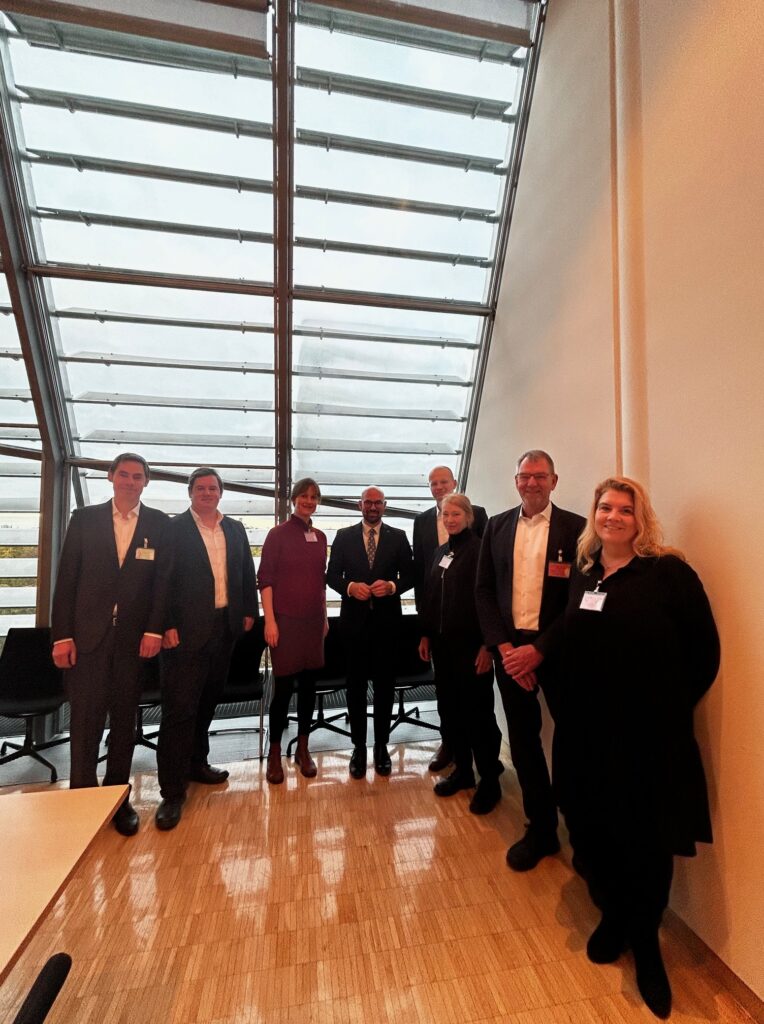
Pictured: Philip Mesenburg (ZDB), Maximilian Meyer (BMKE), Freya Sternkopf (BDE), Mr Bilic presenting the report to Florian Bilic (CDU/CSU parliamentary group rapporteur for circular economy), Matthias Frederichs (bbs), Antje Eichler (HDB), Berthold Schäfer (bbs) and Katrin Mees (DA and BGRB).